Welcome to the latest update for our coloring community! We are thrilled to announce the release of the Future Space Exploration Vol. 2 collection. This brand-new set of pages takes your little astronauts beyond standard rockets and telescopes, introducing them to the highly advanced technology of tomorrow—from sprawling asteroid mining facilities to robotic rovers and deep-space communication buoys.
To help your children and students get the most out of these intricate new designs, we’ve put together a fun guide focused on coloring techniques. Grab your favorite art supplies, and let's make these futuristic scenes pop with texture and light!
Many of our new pages feature heavy machinery, like impressive lunar cargo trains and intricate relay stations.
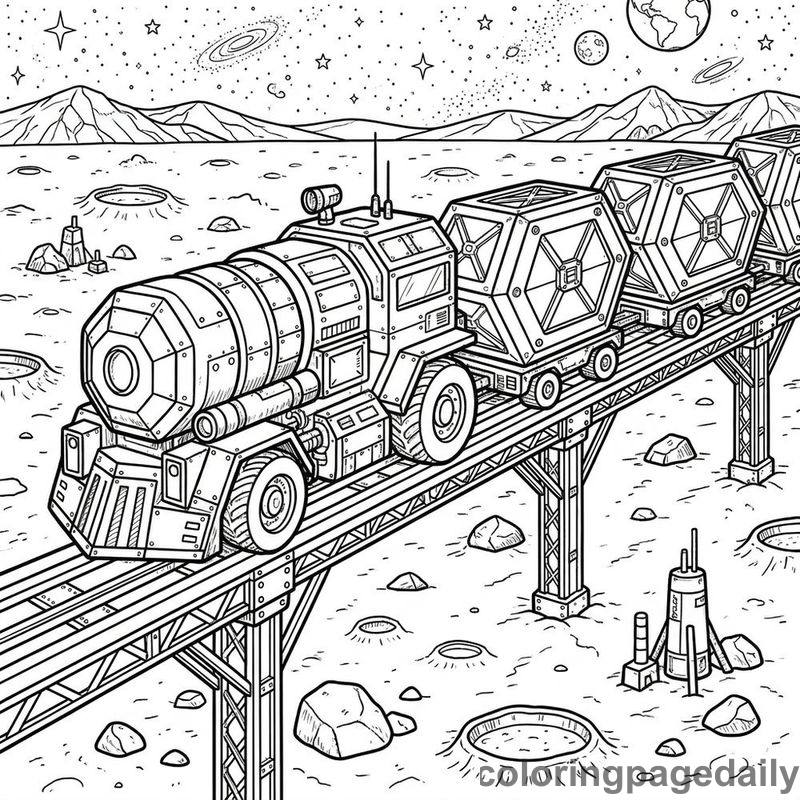
To make these vehicles look like real, shiny metal, encourage your young artists to practice blending. Instead of using a single gray crayon, try layering different shades of silver and gray. Here is a fun art trick: add a very light wash of pale blue over the gray pencil. This mimics the reflection of starlight on steel! Remind kids to leave a few thin, white streaks completely uncolored along the top edges of the train cars to create a bright "glare" or reflection effect.
What is a futuristic space rover without some glowing lights and lasers?
For pages featuring robotic explorers or maintenance drones, you can create a brilliant glowing effect for their mechanical eyes, control panels, and engine thrusters. Use a bright neon gel pen or a fluorescent marker over a base of standard crayon. If you only have colored pencils, color the very center of the light pure white, surround it with a bright yellow or lime green, and press lighter and lighter as you move outward. It will look like the rover is actually illuminating the dark, rocky surface of the asteroid!
While previous updates may have focused on giant gas planets, this update brings you right to the icy edges of our solar system.
When coloring Pluto, ditch the standard flat grays. Did you know Pluto's famous heart-shaped region (known scientifically as Tombaugh Regio) is actually a giant glacier made largely of nitrogen ice? To capture this freezing environment, use combinations of pale blues, soft pinks, and stark whites. To make the planet look like a 3D sphere rather than a flat circle on the page, shade the outer curved edges slightly darker than the center. This technique, called "form shading," is a fantastic and easy beginner art lesson for older kids.
We can't wait to see how your students and children bring Future Space Exploration Vol. 2 to life. Print out your favorite new pages today and let their creativity soar into the cosmos!
This article is part of Future Space Exploration Vol. 2 — browse all 9 coloring pages
