The cosmos just got a little bigger! We are thrilled to announce the latest updates to our Future Space Exploration Vol. 2 collection. This new batch of coloring pages focuses heavily on the incredible machinery, advanced robotics, and distant celestial bodies that make deep space exploration so fascinating.
Whether your little learners are in the classroom or at the kitchen table, these new illustrations offer a fantastic opportunity to practice advanced coloring techniques. Since we’ve already covered how to create stunning galactic backgrounds in a previous update, today we are focusing on how to bring futuristic technology and rocky planetary surfaces to life!
Spacecraft and robots are often made of highly reflective metals to protect them from harsh solar radiation. To help kids achieve a realistic "shiny metal" look, encourage them to blend shades of gray with light blue.
Coloring Tip: Leave a small sliver of the machinery completely white to represent a bright reflection from a nearby star. This technique works perfectly on the mechanical joints and articulated legs of our new Eight-Legged Space Exploration Rover!
What is a futuristic space scene without a little neon glow? Engines, magnetic tracks, and control panels look amazing when they appear to be emitting their own light.
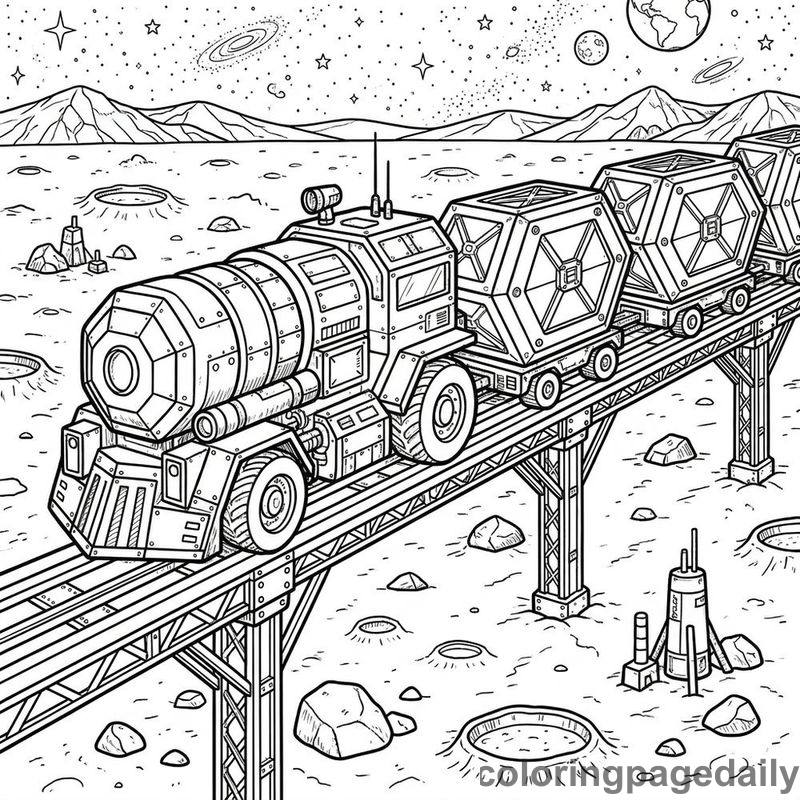
Coloring Tip: To create a glowing effect, start by coloring the very center of a light source (like the undercarriage of a hovering cargo train) with a very pale yellow, or simply leave it bare white. Then, heavily outline that area with a vibrant neon color like electric blue or lime green, gently fading the color outward into the rest of the machinery.
Our new update doesn't just feature human-made tech; we've also added breathtaking celestial bodies like Pluto. Did you know that Pluto features a massive, heart-shaped glacier made mostly of frozen nitrogen and carbon monoxide?
Coloring Tip: When coloring cratered surfaces, consistency is key. Teach children to pick one direction where the "sun" is shining from. Color the inside edge of the crater on the sun-facing side dark, and leave the opposite inside edge light. For Pluto's icy heart, try using soft pastel blues and purples instead of plain white to give the ice a chilly, dimensional appearance.
Satellites and deep-space observatories rely on large geometric solar panels to gather energy from distant stars.
Coloring Tip: Solar panels often look like a grid of shiny glass. Use a ruler to draw a faint diagonal line across the panels. Color one side of the line dark blue and the other side light blue. This creates an instant illusion of a glassy, reflective surface snapping a picture of the universe!
*
We can't wait to see the robotic masterpieces your students and children create with these new pages. Print out the latest additions to the Future Space Exploration Vol. 2 collection today, and let their imaginations launch into orbit!
This article is part of Future Space Exploration Vol. 2 — browse all 9 coloring pages
