As parents and educators, we know that the best learning happens when children are engaged and having fun. Our Magical Spring Gardens Vol. 2 collection isn't just an invitation to explore a fantasy world of whimsical tiny homes—it is also a wonderful jumping-off point for real-world science and history!
While your little artists bring these enchanting dwellings to life, you can share these fascinating educational facts about the everyday objects featured in our latest coloring pages.
In this collection, a giant seashell becomes a cozy home nestled among dandelions. But what exactly is a seashell? Seashells are actually the external skeletons (exoskeletons) of marine animals called mollusks. Unlike human bones that grow inside our bodies, a mollusk has to build its shell from the outside by secreting a mineral called calcium carbonate found in ocean water. As the animal grows, it adds new layers to the outer edge of the shell. This is why you can often see growth lines on them, remarkably similar to the rings of a tree!
Our antique brass microscope home looks like it belongs to a tiny, magical scientist. Microscopes changed the world by allowing us to see things invisible to the naked eye, like cells and bacteria. They work using specially shaped pieces of glass called lenses. When light passes through these curved lenses, it bends (a process called refraction), making the tiny objects underneath appear much larger. The first compound microscopes were invented over 400 years ago in the late 1500s!
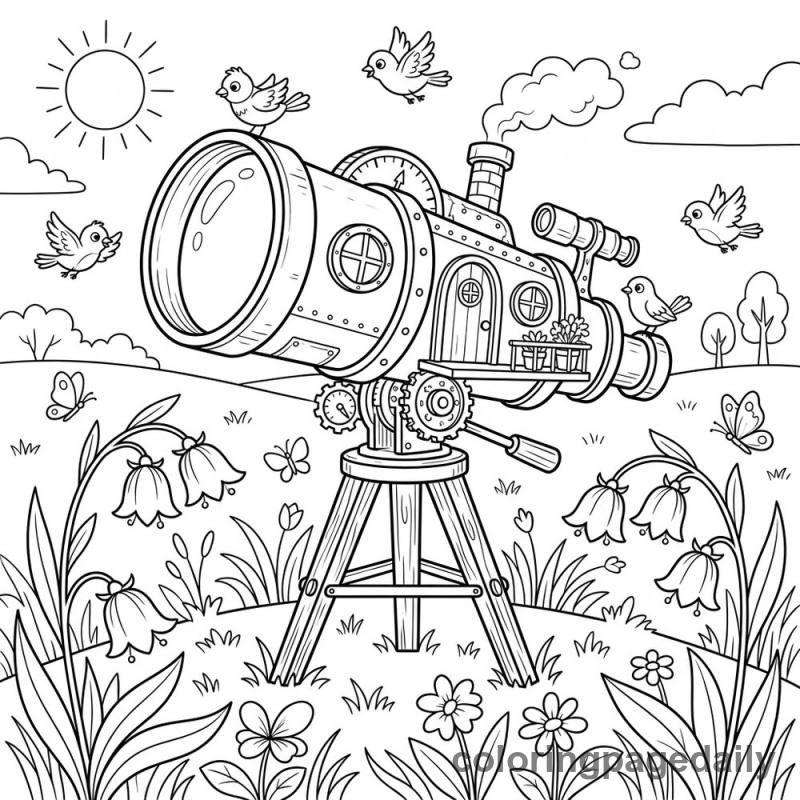
Similarly, telescopes use lenses and mirrors to bend light. But instead of looking at tiny things up close, they collect light from massive objects incredibly far away, like stars and planets. Coloring these pages is a great time to ask children: "If you had a magic lens, would you rather look at a tiny bug up close, or a distant planet?"
Who wouldn't want to live in a house made from a hot air balloon basket? Hot air balloons are the oldest successful human-carrying flight technology, first taking to the skies in 1783. They operate on a very simple scientific principle: buoyancy. Hot air is less dense (lighter) than cold air. When the burner heats the air inside the giant balloon (called the envelope), it becomes lighter than the cooler air outside, causing the whole balloon to gently float upward into the sky.
Our vintage perfume bottle house sparkles beautifully in the meadow. Glass might look like a magical material, but it is actually made from something very common: sand! Specifically, it is made from liquid sand. To turn sand into glass, it must be heated to incredibly high temperatures—around 3,090 degrees Fahrenheit (1,700 degrees Celsius). Once it melts into a liquid, it can be blown, poured, or molded into beautiful, elegant shapes like perfume bottles before it cools and hardens.
The next time your child sits down with their crayons, use these fun facts to turn their coloring session into a captivating science lesson!
This article is part of Magical Spring Gardens Vol. 2 — browse all 4 coloring pages
