Welcome back to our newest collection, Magical Scenery & Hidden Worlds Vol. 2! This time, we are exploring whimsical homes and enchanted terrariums built into giant repurposed objects. While these coloring pages are designed to spark your child's imagination, they also offer a fantastic opportunity for learning.
For parents and teachers looking to combine art time with educational discussions, we have gathered some fascinating, real-world facts about the classic items featured in our new coloring pages. Let's dive in!
Before we had smartphones, streaming services, or even CDs, people listened to music on gramophones! Invented by Emile Berliner and patented in 1887, the gramophone was a revolutionary device because it used flat discs (records) instead of fragile wax cylinders to play sound. As your children color the giant brass horn in this forest scene, you can explain acoustics to them: the large, fluted shape of the horn naturally amplified the music so the whole room could hear it, entirely without electricity!
Modern kids are used to tapping a screen to call Grandma, making the rotary telephone a fascinating piece of history. The rotary dial was patented in 1891 by an undertaker named Almon Brown Strowger. Before his invention, people had to speak to a human operator who would manually plug wires into a switchboard to connect their call. Strowger's mechanical dial allowed people to take control and route the calls themselves.
This magical page combines two amazing inventions! First, the commercially practical incandescent lightbulb was developed by Thomas Edison's team in 1879, changing how the world lived after dark. Second, the terrarium inside it represents a self-sustaining ecosystem. The first terrarium was accidentally invented in 1842 by Dr. Nathaniel Bagshaw Ward. He discovered that plants could thrive in a sealed glass container because they create their own miniature water cycle—moisture evaporates, condenses on the glass, and “rains” back down onto the soil.
Cuckoo clocks originated in the Black Forest region of southwestern Germany during the early 18th century. When coloring this page, point out the heavy pinecones hanging from the bottom of the clock. These aren't just decorative! Traditional cuckoo clocks don't use batteries. Instead, those pinecones are cast-iron weights. As gravity pulls the weights down on their chains, they power the internal gears that keep the pendulum swinging, track the time, and trigger the famous "cuckoo" bird call.
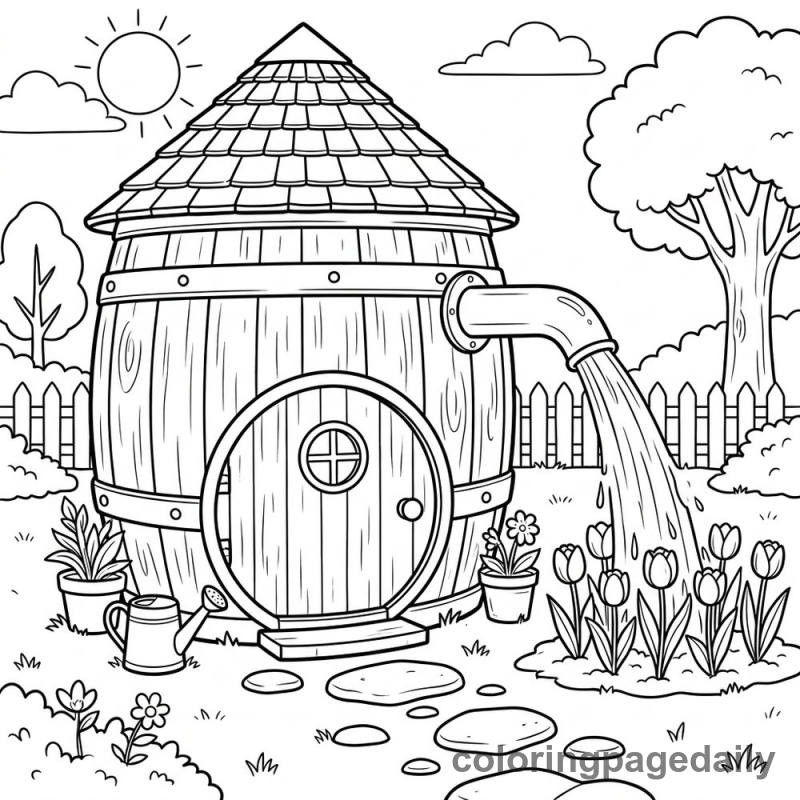
Rainwater harvesting is a practice that dates back thousands of years to early agricultural societies. This cozy rain barrel house is a great starting point to talk to kids about water conservation and the environment. Because rainwater lacks the chemicals (like chlorine) often found in treated tap water, plants absolutely love it. Collecting rainwater reduces runoff and helps families save on their water bills during the spring and summer gardening seasons.
Next time your little ones sit down with their crayons, share these fun facts with them. You'll be amazed at how quickly a simple coloring session can turn into an engaging lesson on history, engineering, and science!
This article is part of Magical Scenery & Hidden Worlds Vol. 2 — browse all 12 coloring pages
