Welcome to the latest update for our Future Space Exploration collection! If your children or students are captivated by the mysteries of the cosmos, they will be thrilled by our newest additions. We have just uploaded a fresh batch of highly detailed coloring pages featuring advanced deep space probes, high-tech satellites, and exploratory lunar rovers.
These pages aren't just a fun creative outlet; they are fantastic educational tools to spark conversations about STEM, space engineering, and planetary science. Here is a look at what is new, along with some fun facts and coloring tips to share with your budding astronauts!
Our new Hexagonal Space Probe page is perfect for kids who love intricate machinery.
Space Fact: Real-world space probes use advanced thermal protection systems to survive extreme temperatures. For example, NASA's Parker Solar Probe uses a specialized carbon-composite heat shield to withstand the intense heat of the Sun!
Coloring Tip: Encourage children to experiment with metallic colored pencils. Coloring the hexagonal heat shield with stark white, reflective silver, or bronze can mimic real thermal protection materials and make the technology look highly advanced.
Next up is the Futuristic Radar Space Satellite, featuring massive circular dishes extending into the void.
Space Fact: Radar satellites don't rely on visible light. Instead, they bounce radio waves off planetary surfaces to create maps. The Magellan spacecraft used radar to map the surface of Venus, peering right through its thick, toxic clouds!
Coloring Tip: To make the radar dishes look three-dimensional, have kids practice shading. By coloring the center of the concave dishes with darker grays and leaving the outer rims lighter, they can create a realistic illusion of depth and curvature.
For fans of astronauts and vehicles, the Astronaut Driving Moon Buggy offers an action-packed scene on the cratered lunar surface.
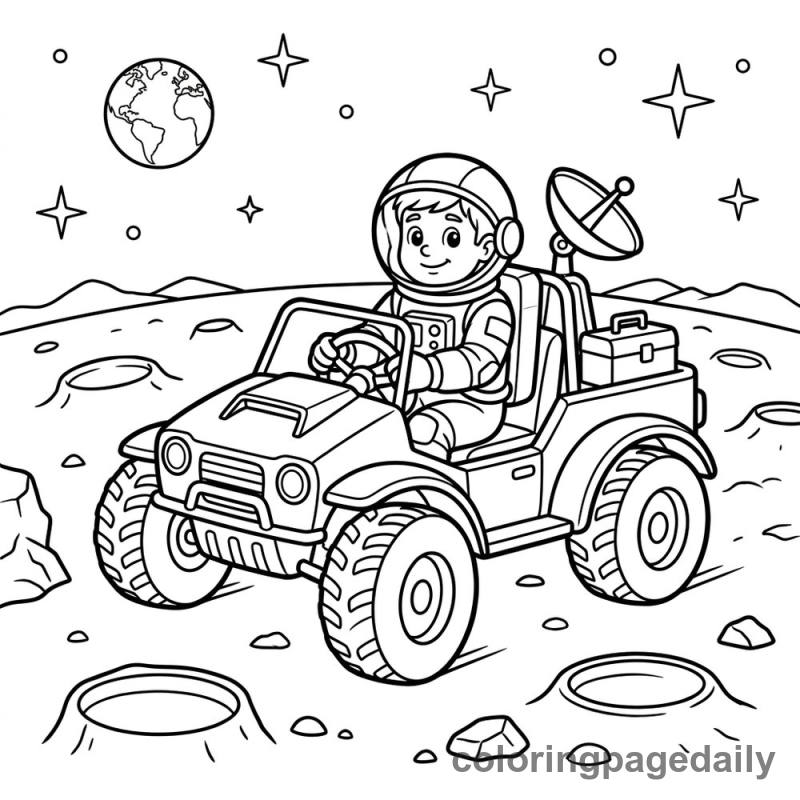
Space Fact: The original Apollo Lunar Roving Vehicles (LRVs) were marvels of engineering. To save space on the spacecraft, they were designed to be incredibly lightweight and actually folded up to fit inside the Lunar Module!
Coloring Tip: The moon isn't just one flat shade of gray. Teach your students to use cross-hatching or blending techniques with varying shades of charcoal, slate, and even dusty browns to give the cratered rocks a rugged, realistic texture.
Finally, we've added the Pyramid Space Habitat Module, which challenges kids to imagine human life on a rocky asteroid.
Coloring Tip: This page is all about lighting and contrast. To make the glowing greenhouse stand out against the desolate asteroid, suggest using vibrant neon greens and bright yellows for the indoor plants and lights. This will create a striking contrast against the dark, heavily textured space rocks surrounding the base.
Ready to embark on a coloring mission? Print out these new pages today and let your young explorers engineer their very own colorful universe!
This article is part of Future Space Exploration — browse all 8 coloring pages
