Welcome back, space enthusiasts! If your young artists are ready to take their sci-fi masterpieces to the next level, our Future Space Exploration collection is the perfect launchpad. While we've previously covered how to create stunning galactic backgrounds, today we are focusing on the incredible machinery, scientific tools, and habitats that make up our cosmic future.
Here are some creative tips to help children (and adults!) add incredible depth, texture, and realism to these highly detailed coloring pages.
Many real-world and futuristic spacecraft are covered in specialized metals and thermal insulation to survive the harsh, freezing environment of deep space. To achieve a realistic metallic look on pages like our space probes, encourage kids to use a combination of light gray, silver, and pale blue colored pencils. The trick is to leave a few thin, uncolored white streaks along the edges of the metal panels to mimic the reflection of distant stars. For heat shields, a blend of copper, bronze, and bright orange can give a realistic, heat-resistant appearance!
Space habitats are beacons of life in the dark expanse of the cosmos. To make botanical greenhouses and habitat windows look like they are truly glowing from within, teach your kids the "halo effect" art technique. Start by coloring the very center of the window or dome with a very light yellow, or even leave it completely white. Then, press harder with neon greens, bright blues, or warm yellows around the outer edges. This contrast tricks the eye into seeing a radiant light source shining out into the darkness of the asteroid belt.
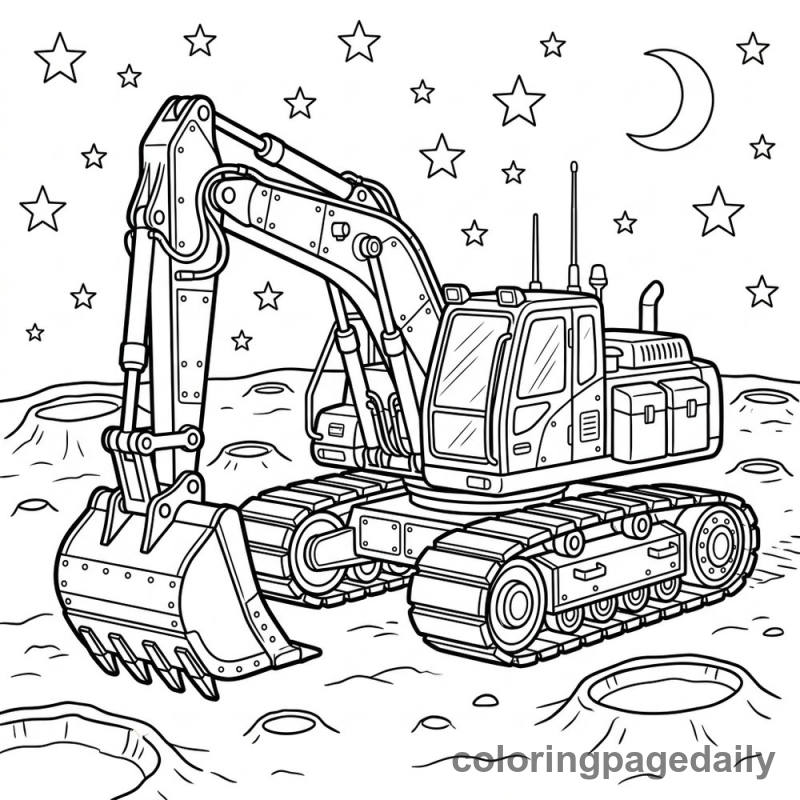
When heavy machinery like our lunar mining excavators roll across the moon, they kick up plenty of space dirt! While it’s tempting to color the moon with a single gray crayon, lunar regolith (moon dust) actually contains subtle hints of charcoal, brown, and even dark reddish-orange depending on the local mineral content. Have your students layer different shades of gray and lightly stipple (dot) the surface with darker colors to create a rough, dusty texture. To make the craters look deep, shade the inside edge furthest from the light source with a heavy black or dark gray pencil.
Space might be a vacuum, but that doesn't mean it lacks action! For moving vehicles like our space debris sweeper, kids can convey motion by using directional shading. By coloring slightly blurred, horizontal lines behind the spacecraft using silver or light blue, they can create "action lines" that make the robotic vehicle look as though it's gliding swiftly through orbit to catch stray satellites.
By introducing these simple but effective art techniques, parents and teachers can help children develop fine motor skills, learn about light and shadow, and spark a lifelong interest in STEM and space exploration. Grab your colored pencils and let your imagination soar!
This article is part of Future Space Exploration — browse all 8 coloring pages
